

A dining table travels safely when the legs come off and the top rides flat, wrapped as a single padded panel. Chairs move separately, stacked seat to seat with padding at every contact point, because the joints give way long before the wood does. Moving Mountains provides full-home moving for Peoria households, and a dining set is the piece most often damaged on a self-move. Estimators check doorway widths, stair turns, and the carry to the truck before a date is booked. That walk is why a tabletop never meets a stair rail on the way out. Measure your top, then measure the narrowest door it has to clear.
Do the Legs Have to Come Off Your Dining Table?
Most tables lose their legs for the trip, and the reason is geometry rather than caution. A forty-two-inch top will not turn a thirty-six-inch doorway while four legs still hold it square. Taking them off turns an awkward object into a flat panel that two people can steer.
Pedestal tables are the exception worth checking. A single central column often unbolts from the underside in four turns, and some do not come apart at all. If the base is fixed and the whole piece still clears your doors, it travels assembled with the column padded separately. Look underneath before you decide, because the answer is usually visible in ten seconds.
Hardware disappears faster than anything else in a move. Bag the bolts and washers from each leg, then label the bag. Tape it to the underside of the top, where it cannot migrate into a carton. Photograph the underside before you touch a bolt. Reassembly at the other end then takes minutes instead of an evening of guessing.
How Do You Protect a Tabletop in Transit?
Wood finishes mark from pressure and from rubbing, as much as from impact. A blanket thrown loosely over a top shifts on the road. It polishes a dull patch into the finish by the time the truck arrives. The wrap has to be tight enough to stay put and padded enough to absorb a knock.
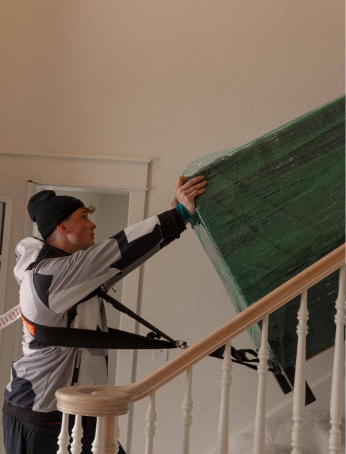
Work from the inside out. A layer of clean paper or a moving pad goes against the finish. A second pad covers the corners, and tape never touches the wood itself. Corners take the worst of it, so double the padding there and tape each pad to itself. Glass and stone tops need more again.
Have these ready before anything gets wrapped:
- Moving pads or clean paper, enough for two layers across the top and four at the corners
- A roll of stretch wrap, used over the pad and never against bare wood
- A labeled hardware bag for every set of legs, bolts, and washers
- A screwdriver and hex key set that matches your fittings, checked the day before
- A clear staging space, usually the garage, where the top can lie flat while the chairs go out
The staging space does more work than the materials do. A top propped against a wall in a busy hallway gets knocked, and a top lying flat in an empty garage does not. Clear that space before you start rather than while you are holding one end of a table, since preparing your home for movers comes down to clearing routes first.
What Is the Right Way to Pack Dining Chairs?
Chairs look simple and account for more damage than the table does. The weak point is the joint where the leg meets the seat rail, and it loosens under exactly the kind of sideways pressure a loose stack creates.
Stack them in pairs, seat to seat, with a pad between the two surfaces so the finishes never touch. Three chairs high is the practical limit for most dining chairs, and two is better where the backs are spindled. Wrap each pair together once stacked, then tie the stack so it moves as one object.
Upholstered seats need a cover rather than padding. Stretch wrap over fabric traps moisture through a humid Central Illinois summer, so a clean cotton sheet goes on before any plastic. Remove slip seats where they unscrew from below, since four screws turn a bulky chair into two flat pieces.
Not sure whether your dining top will clear the doors and stairs on its route? Give us a call at (309) 274-0694, and we’ll walk the route with you and give you a free estimate before any date is held.
Which Dining Tables Need More Than a Standard Wrap?
Material decides the method more than size does. A solid oak farmhouse top and a glass top of identical dimensions are two different jobs with two different failure modes.
| Table type | What changes | How it rides |
| Solid wood | Legs off, corners double padded | Flat, strapped against the truck wall |
| Glass top | Crated or edge protected, never stacked | Upright on edge, braced |
| Stone or marble | Weight and brittleness together, more hands | Upright on edge, never flat |
| Extension table | Leaves out and wrapped individually | Leaves flat with the top, mechanism padded |
| Antique or inherited | Finish and joints both fragile, no tape | Flat, isolated from other items |
Extension leaves go missing more often than they break. They live inside the table, so they are easy to forget until the dining room is empty and the truck is loaded. Pull them out at the packing stage and wrap each one on its own. Keep them with the top rather than in a carton of linen.
Marble and glass tops are the two worth declaring at the estimate. Both are heavy, both are brittle, and both change the crew size and the equipment we bring. An inherited piece belongs in the same conversation, because the value is not in the dimensions and we plan around it differently.
How Peoria Homes Change the Dining Room Job
Peoria, IL is built on a bluff, and the housing stock follows it. A West Bluff house on a narrow lot with a rear alley is one kind of carry. A newer home off Knoxville with a straight drive to the door is another.
Older bluff homes were built before anyone designed around a six-seat table. Front steps are steep, back staircases turn tightly, and doorways were cut narrower than any modern floor plan allows. A top that would ride out of a ranch house assembled has to come apart here. The turn at the landing usually decides it.
Downtown condos bring a different limit. A service elevator and a booked loading dock set the window you have. The dining set then goes down in a planned sequence rather than whenever it is ready. That same kind of scheduling constraint drives a commercial move checklist for Peoria, where elevator reservations and loading dock windows decide the day as much as the inventory does. The subdivisions on the north edge of the city are the easiest of the three, where the question is volume rather than access. The estimate confirms which of those you are on, and the answer changes the crew we send.
Frequently Asked Questions
Four questions come up on almost every dining room call we take.
How far ahead should a dining set be taken apart?
The day before the move is enough for most sets, and it keeps you from eating off the floor for a week. Take the legs off, bag the hardware, and stage the top flat somewhere out of the traffic path. Where the table is antique, or the bolts are seized, give yourself two days instead of one.
Can you move a dining table without taking the legs off?
Sometimes. A small table with a narrow footprint will clear a standard door and a straight stair while assembled. The limit is the diagonal of the top measured against the narrowest opening on the route, so check both before deciding. Anything that has to turn on a landing usually comes apart.
Do dining chairs need to be wrapped individually?
Pairs rather than singles. Two chairs stacked seat to seat with a pad between them wrap as one unit and ride better than six wrapped separately. Spindle backs and upholstered seats are the exceptions worth extra care, since thin backs snap and pale fabric marks under plastic.
What should we tell you about the dining room at the estimate?
Tell us the top material, whether it extends, and how many chairs are going. Mention any piece that is antique or inherited. Then describe the route out, including stairs, turns and where a truck can park. Those answers set the crew size and the equipment we load on the day.
Talk to Us About Your Peoria Move
Book the free estimate, and we will walk the route with you, from the dining room to the truck, before any date is held. Call (309) 274-0694, Monday to Friday 8:00 AM to 5:00 PM and Saturday 9:00 AM to 4:00 PM.
We serve Peoria, IL, and the Central Illinois towns around it, and the walkthrough costs nothing either way. Bring us the awkward pieces rather than the easy ones, because those are the ones that decide how the day runs.
Related Topics: