
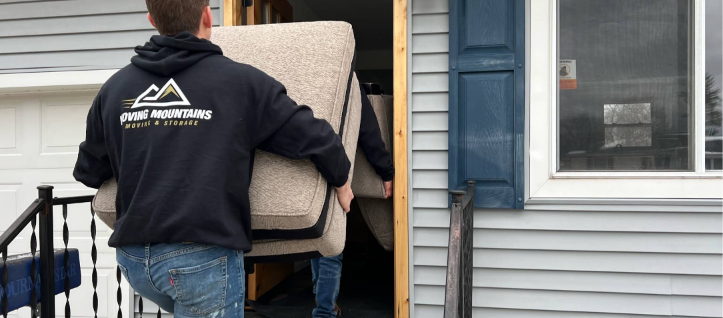
A mattress needs a sealed mattress bag before it leaves the bedroom. A bed frame needs its hardware bagged and taped to the headboard before any bolt comes out. Those two habits prevent most of what goes wrong with beds on moving day.
Moving Mountains moves households throughout Peoria, Illinois, and the bed is usually the last thing taken apart and the first thing wanted back together. Crews break down and rebuild frames as part of whole-home moving for Peoria households, which is why bed types come up at the estimate. Count your beds, then count your mattress bags.
Why a Mattress Bag Is Not Optional
A mattress is a sponge wrapped in fabric, and neither a truck floor nor a driveway is a clean place. Whatever it touches on the way out, it keeps.
Plastic mattress bags cost a few dollars each and seal with tape along one edge. They stop dirt, water, and the scuffing a bare mattress picks up against a door frame on the way down a staircase. A bag also gives the crew something to grip, which matters more than it sounds on a narrow landing.
Rain settles the argument. A Central Illinois spring can turn a dry morning into a wet load halfway through. An unbagged mattress then soaks up water across a twenty-foot carry. Wet foam does not dry properly, and it does not recover its shape.
Can a Mattress Travel on Its Side?
Most traditional innerspring mattresses tolerate a short move on edge without harm, which is how they clear doors and stairs in the first place. The question is how long they stay that way.
Memory foam, latex, and hybrids behave differently. Left on edge for hours, they settle out of shape, and the heavier the foam, the worse the result. Carrying one on edge down a hallway is fine, and leaving it standing in a truck overnight is not.
Flat on top of the load is the position we aim for, with nothing stacked above it. The mattress then acts as a cover for everything underneath, which is a second reason the bag earns its cost. Where the load will not allow flat, a foam mattress rides on edge supported along its full length rather than leaning at an angle.
Taking a Bed Frame Apart Without Losing the Hardware
Hardware loss is the reason a bed sits in pieces on a bedroom floor at eleven at night. Every frame uses its own bolts, and almost none of them are replaceable at a hardware store on a Sunday.
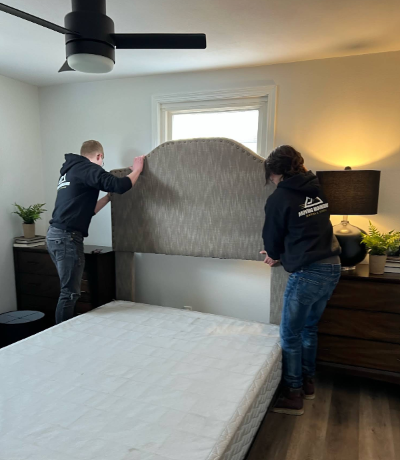
Work the frame down in this order:
- Photograph the assembled frame from two angles, including the joint detail
- Strip the bedding, then set the mattress and base aside, already bagged
- Remove the slats or platform and band them together as one bundle
- Take the side rails off last, so the headboard and footboard stay supported
- Bag every bolt, washer, and bracket; label the bag; tape it to the headboard
Taping the bag to the headboard rather than dropping it into a carton is the part that matters. Cartons get opened, moved, and unpacked in a different room from the bed. A bag taped to the piece it belongs to arrives exactly when the frame arrives.
Slats are worth banding rather than boxing. A loose slat is the right size and shape to slide behind something and surface a month later. Banded into a bundle, they load with the rails and come off with them.
Have an adjustable base, a bunk bed, or a platform frame? Give us a call at (309) 274-0694, and we’ll plan the breakdown and rebuild before moving day.
Adjustable Bases, Bunk Beds and Platform Frames
Standard frames come apart the same way almost everywhere. The types below do not, and each one surprises somebody on a moving day.
| Bed type | What makes it different | What we need to know |
| Adjustable base | Motor, wiring, and a power supply | Whether it folds, and where the control box sits |
| Bunk or loft bed | Many fasteners, often a fixed ladder | How it was assembled and whether parts are original |
| Platform with storage | Drawers and gas lift mechanisms | Whether drawers come out and how the lift releases |
| Upholstered frame | Fabric marks and corner crush | Whether it splits or has to travel whole |
| Antique wooden frame | Pegged or bolted joints, often brittle | Its age and whether it has been apart before |
Adjustable bases are the ones to declare early. They are heavy, they carry electronics, and some fold while others come apart into sections that reassemble only one way. Photograph the wiring before anything is unplugged, because the control box seldom carries a diagram.
Bunk beds take longer than people expect, often an hour to break down and longer to rebuild. Where a move is happening around children, that timing is worth planning for rather than finding out on the day. We can rebuild the bunk the same evening provided it is sequenced into the unload.
Getting a Bed Down a Peoria Stairwell
Bedrooms sit upstairs, and in Peoria, IL that frequently means a turning staircase built long before king-size anything existed.
Older homes on the West Bluff and around The Uplands have back stairs with a landing turn and a low ceiling above it. A king mattress on edge needs the diagonal of that turn, and a boxed platform base often will not make it at all. Estimators measure the route and tell you which pieces have to split before the day rather than during it. Put that route on a week-by-week moving checklist, so it is clear before the crew arrives.
The alternative is a window or balcony exit, which gets planned rather than improvised. Newer homes on the north edge of the city rarely need any of this, since the stairs run straight and the landings are wide enough. Knowing which house you have is the difference between a two-hour bedroom and a four-hour one.
Beds are the one room everybody wants back together the same night. Call Moving Mountains at (309) 274-0694, Monday to Friday 8:00 AM to 5:00 PM and Saturday 9:00 AM to 4:00 PM, or request a free quote online, and tell us how many beds are going and what type each one is. We’ll sequence the bedrooms, so they go up before the cartons do.
Related Topics: