
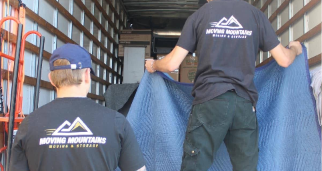
Rugs travel rolled and never folded, and they have to be clean and completely dry before the roll starts. A folded rug carries its creases for months, and a damp one grows mildew inside the roll within days. Moving Mountains sends residential movers across Peoria, Illinois, and offers packing and unpacking services alongside the move itself, and rugs are the item most often loaded last and prepared least. Our crews roll and cover rugs as part of the load, though a rug still damp that morning is beyond anyone’s help. Give yourself the week before the move to get them cleaned and properly dried.
Why Rugs Are Cleaned Before They Are Rolled
Dirt inside a rolled rug has nowhere to go and several days to work. Grit grinds into the pile under the weight of the roll itself. Whatever was in the fibers stays pressed against them until the rug comes out.
Professional cleaning needs lead time, usually a week or more for a large wool rug, and drying is the part people underestimate. Central Illinois summers run humid enough that a rug feeling dry on the surface is often still wet at the base of the pile. Give it an extra day in a room with moving air before you commit it to a roll.
Vacuuming both sides is the minimum when cleaning is not realistic. Lift the rug, vacuum the floor beneath it, then vacuum the back of the rug, which usually holds more than the face does. Beating a rug outdoors still works, and it beats doing nothing at all. Deciding which rugs earn the cleaning bill belongs with sorting and decluttering before packing.
Rolling a Rug Properly
Direction matters more than effort here. A rug rolls pile side in, which protects the face and leaves the backing on the outside where scuffs do no harm.
Work through it in this order:
- Clear the full length of the rug and vacuum the floor underneath it
- Fold one short edge over by six inches so the roll starts straight
- Roll from that short end, keeping tension even across the width
- Tie at three points, both ends and the middle, using flat cotton strapping
- Cover the roll in sheeting or a rug bag, taped at the ends only
Thin string cuts into pile under its own tension, and tape against a rug face lifts fibers when it comes off. Flat cotton strapping or wide fabric ties spread the load and leave nothing behind them. Three ties also stop the roll from telescoping when somebody lifts it from one end.
Large rugs want two people and a straight run of floor. Rolling a twelve-foot wool rug alone produces a crooked roll that will not sit flat on the truck. A crooked roll is also the one that comes undone in transit.
Not sure how your rugs should be prepared and loaded? Give us a call at (309) 274-0694, and we’ll plan around the long rolls with a free quote rather than finding them on the morning.
Covering and Labeling the Roll
A wrapped roll is anonymous. Five of them standing against a truck wall look identical, and the one you want is always at the back of the five.
Label each roll at both ends with the room it came from and the room it is going to. Write on the cover rather than on a tag, since tags tear off during a carry. A rug destined for the upstairs back bedroom should say so on the wrapping, because the alternative is carrying it twice.
Covering handles moisture and abrasion at the same time. Plastic sheeting keeps a roll clean against a truck wall, though a rug sealed in plastic for weeks is a different proposition entirely. Where rugs are going into moving storage between homes, breathable covers beat plastic every time.
Where Rugs Belong in the Load
Rugs go among the last things onto the truck and the first things off it. That is the opposite of how most people expect the day to run.
| Rug type | How it is prepared | Load position |
| Large wool or silk | Cleaned, rolled pile in, breathable cover | Last on, lying flat on top |
| Synthetic area rug | Vacuumed, rolled, sheeting cover | Upright against the wall, strapped |
| Runner | Rolled tight, tied at two points | Tucked along the side of the load |
| Rug pad | Rolled separately from its rug | Anywhere, it is forgiving |
| Antique or hand knotted | Cleaned, rolled on a tube, declared early | Flat on top, nothing above it |
The reason is unloading order. Rugs go down before furniture at the new address. A rug buried under a bedroom suite has to come out of the middle of a packed truck. Loading them last costs nothing and saves a shuffle at the other end.
Rug pads deserve a roll of their own. Rolled inside the rug they distort the pile and hold moisture against the backing. Rolled separately, they take almost no space, and they are the one item on the truck that nothing can really hurt.
Wall to Wall Carpet and What Stays Behind
Fitted carpet forms part of the house in almost every sale, and lifting it is rarely worth the result. A carpet cut to one floor plan seldom fits another one.
Where a carpet is genuinely coming out, perhaps a recent install in a rental, the lift is a flooring job rather than a moving one. Tack strips, underlay, and transition pieces all come into it, and a carpet pulled badly cannot be relaid. Have it lifted and rolled before the move date so the crew is loading a roll rather than waiting on one.
Peoria, IL houses on the bluff often have original hardwood under decades of carpet, which is worth knowing before the rug conversation starts. A seller pulling carpet before listing is doing a different job from a mover, on a different timeline, with different people. Our crews work around a floor that is mid-project, provided we know it is happening when we quote the move.
Rugs are easy to prepare badly and simple to prepare well. Call Moving Mountains at (309) 274-0694, Monday to Friday 8:00 AM to 5:00 PM and Saturday 9:00 AM to 4:00 PM, or request a free quote online, and tell us how many rugs are going and whether any of them are antique. We’ll roll, cover and load them with everything else.
Related Topics: